
AI & ML in Space Exploration
Introduction
This specialized training program is designed to introduce students, faculty, and scholars to the practical applications of Artificial Intelligence (AI) and Machine Learning (ML) in the space sector. With increasing mission complexity, vast data volumes from advanced sensors, and the growing need for autonomous systems, AI and ML are becoming indispensable tools in space science and engineering.
The program provides focused instruction on applying AI/ML techniques to real-world space challenges, including mission operations, space data analysis, and onboard autonomy.
Training Content
- Day 1 — Foundations of AI & ML in Space
- Day 2 — Space Exploration & Robotics
- Day 3 — Satellite Operations
- Day 4 — Spacecraft Systems & Autonomy
- Day 5 — Space Data Analysis & Pattern Recognition
- Day 6 — Advanced Applications & Case Studies
Program Start Date: 23 February 2026
Program End Date: 28 February 2026
Session Length: 90 Minutes (Per Day)
Total Duration: 6 Days
Venue: Zoom Platform
Language: English
Eligibility: Undergraduate & Postgraduate students, Faculty members, research scholars, Enthusiasts.
Tuition Fee: ₹1200/- (Students)
Certificate: Participants will receive an official Training Completion Certificate, A Project Completion Letter and Project Evaluation Report will be given to those participants who undergoes project work.
Registration Start Date: 02nd January 2026
Registration End Date: 10th February 2026 till 11:55 pm
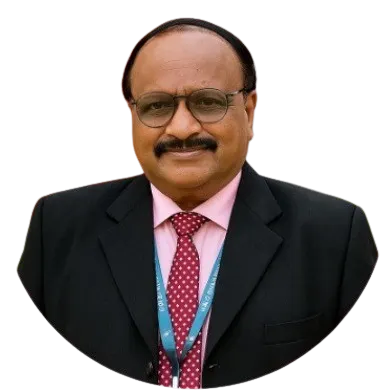 Program Supervisor
(Dr. Ashok Gopalakrishan)
Chairperson at International Space University, France
Consultant to Spectragaze (An ISRO Company for Satellite Development-Private Sector)
Dr. Ashok Gopalakrishnan is a senior academician and researcher with over three decades of experience in the fields of computer science, aerospace engineering, artificial intelligence, and environmental modeling, having served in key capacities at institutions such as NASA, IBM, the University of Texas at Austin, and ISRO.
He holds dual PhDs from the Georgia Institute of Technology, an MS from Oxford University, and an M.Tech from IIT Bombay.
His contributions include AI-based space mission planning systems such as Eagle Eye and CASPER at NASA, as well as ongoing research on black hole binaries supported by ISRO.
Dr. Gopalakrishnan has published over 285 research papers in reputed journals and has been recognized with awards such as the IBM WebSphere Champion (2013), the Indian Achievers Award for Excellence in Education (2017), and the Top 100 Global Leaders in Education (2019).
He currently serves as Professor Emeritus and leads multiple national space science outreach and education initiatives at the United Institute of Technology, Coimbatore, in collaboration with ISRO and other agencies.